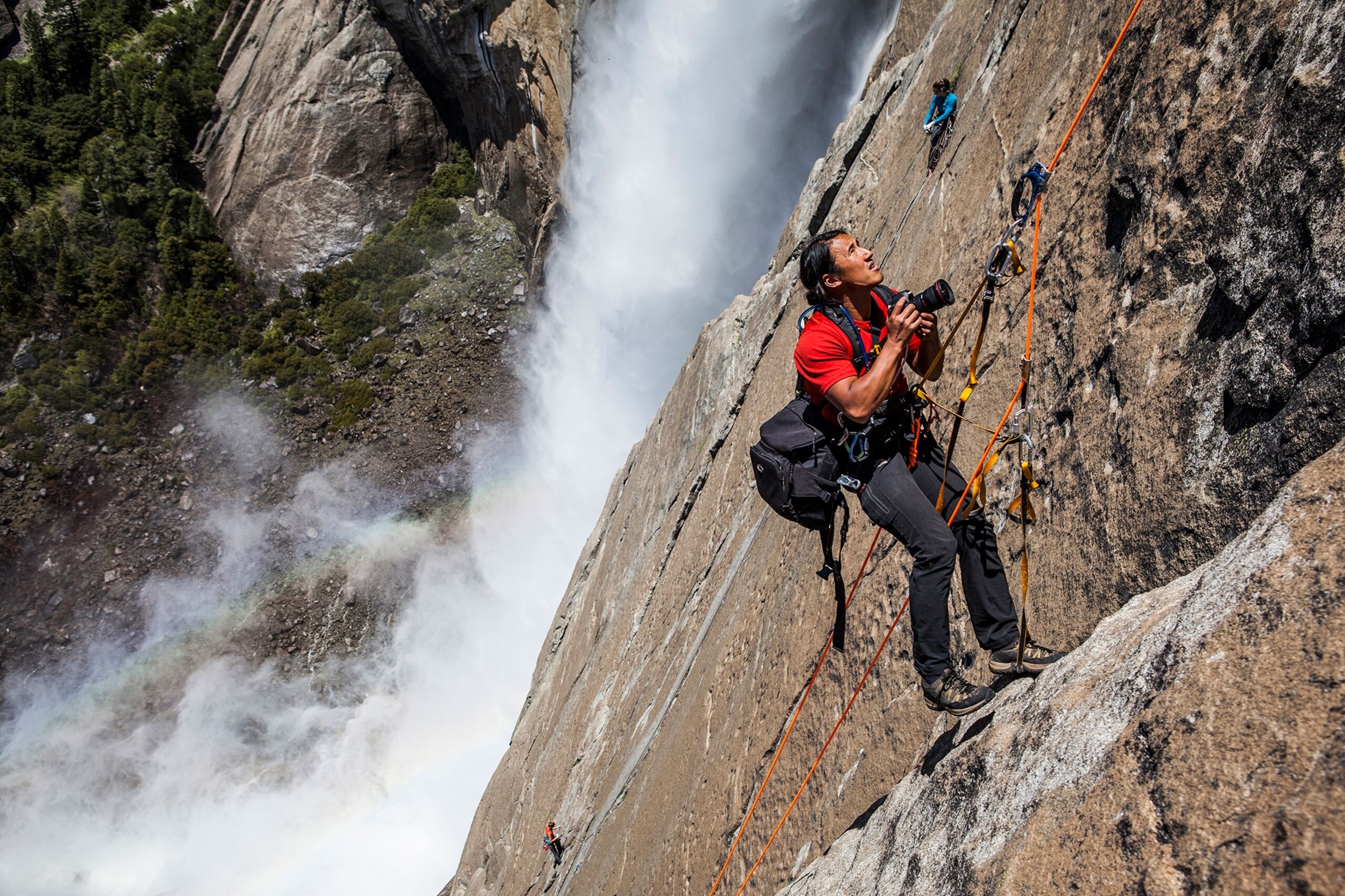
Climbing came before the career plan
Chin grew up in Mankato, Minnesota, where his parents worked as librarians. His childhood involved music, study and sport. In his Roadtrip Nation account of choosing a different career, he recalls believing his options were medicine, law or business. Skiing and climbing offered something he had chosen for himself.
After college, he proposed taking a year to climb and ski. It became seven years living out of a blue Subaru, with odd jobs helping him get by. He describes the freedom alongside the daily doubt: he had a degree, but no clear picture of where this life would lead.
That uncertainty is part of the story. The photographs did not begin as the final step in a carefully arranged business plan. They grew out of the places he was going and the people he was climbing with.
A $500 photograph made another life possible
Chin’s first sale came from a borrowed camera. As National Geographic’s account of his first professional photograph describes it, climbing partner Brady Robinson showed him the controls. Chin later photographed Robinson asleep at their campsite on El Capitan. Robinson sold the image to Mountain Hardwear for $500.
The next opportunity took more persistence. Preparing for an expedition to Pakistan, Chin repeatedly visited photographer Galen Rowell’s gallery, hoping for advice. Rowell eventually sat down with him, showed him photographs of the area and encouraged him to take a camera.
Chin returned with pictures of the climbing he and Robinson had done. At an outdoor industry trade show, those photographs covered Mountain Hardwear’s booth. His experience on the mountain had become work that a company wanted other people to see.
Conrad Anker helped turn promise into assignments
Conrad Anker became a mentor who connected Chin’s climbing and photography. In 2001, he helped Chin secure a North Face campaign and athlete sponsorship. Chin’s account of Anker’s support and the Tibet breakthrough makes those relationships central to his progress.
In 2002, Chin joined Anker, Rowell and Rick Ridgeway on a crossing of Tibet’s Chang Tang Plateau. His photographs appeared in National Geographic in April 2003. The assignment also helped his parents understand the value of the path he had taken.

Moving pictures brought another apprenticeship. In his later interview about learning filmmaking on expeditions, Chin describes Ridgeway teaching him to think in sequences and scenes during the Tibet trip. They then spent months assembling the footage. Getting the shot was only the beginning of making a film.
Send your own photos and footage with HeftySend.
When an editor or client needs your files, HeftySend lets you send up to 100 GB free without an account, with three day expiry. Your recipient does not need an account to download. Our guide to sending large video files explains the delivery options.
Meru needed more than extraordinary footage
Meru became a breakthrough because Chin and his collaborators found a way to shape the experience into a film. It followed Chin, Anker and Renan Ozturk’s attempts on the mountain’s Shark’s Fin. But its route to an audience was far from straightforward.
Chin told National Geographic that Meru had reached a point with no financing or support. He sought private investors and teamed up with Elizabeth Chai Vasarhelyi to direct it. Together, they rewrote the film, recorded the interviews again and reconsidered its structure.
His explanation is practical: compelling events do not automatically make a compelling film. The order of information, timing and restraint mattered. Vasarhelyi brought a wider documentary perspective to a story Chin had lived inside.
Free Solo put trust behind the camera
Free Solo brought Chin and Vasarhelyi the documentary Oscar in 2019. Their film followed Alex Honnold’s ascent of El Capitan without ropes, with a difficult question behind every filming decision: could the cameras alter what he did?
In their PBS interview about the responsibility of filming Free Solo, Chin explains that he wanted to capture events without influencing them. His experience on both sides of the camera helped him recognise how its presence could feel.
The crew needed an unusual combination of abilities. Those filming high on the wall had to be elite climbers as well as excellent cinematographers. While Honnold practised the climb, the crew practised filming it. The work depended on preparation and judgement, alongside the physical ability to reach a position.
What made Jimmy Chin successful?
Chin’s career joined knowledge of a subject with a willingness to learn new ways of showing it. Climbing led to photography; experienced collaborators helped him develop; filmmaking demanded that he learn structure as well as capture.
His answers to aspiring adventure photographers offer a useful qualification to the spectacular images. On expeditions such as Meru, he described himself as a climber first and a photographer second. The camera did not remove his responsibility to assess the situation around him.
For another creative who built a career around understanding a subject deeply, read our story about Cristina Mittermeier’s move from marine biology to conservation photography.
Frequently asked questions
How did Jimmy Chin start professional photography?
A photograph he took with climbing partner Brady Robinson’s camera sold to Mountain Hardwear for $500.
Who helped Jimmy Chin get his first major assignments?
Conrad Anker helped him secure a North Face campaign and his first National Geographic assignment.
Did Jimmy Chin plan to become a filmmaker?
No. In his Canon interview, Chin says he had not set out to be either a photographer or a filmmaker.
Who directed Free Solo with Jimmy Chin?
Elizabeth Chai Vasarhelyi directed Free Solo with Chin. The film won the documentary Oscar in 2019.