Quick answer
A low storage price is only one line of a delivery budget. Before moving client files into your own bucket, write down the whole handover: the originals, the collection period, the expected downloads and the people responsible for keeping it working.
What belongs in your file delivery budget?
| Budget line | What to measure |
|---|---|
| HeftySend plan | Your monthly subscription or the initial Lifetime purchase |
| Stored data | Files retained across the billing period, including extra copies |
| Requests | Operations that write, list, inspect or read objects |
| Retrieval and delivery | Data read from the chosen storage class and sent to recipients |
| Other costs | Backups, optional services, taxes and your administration time |
These are separate measurements. For example, Amazon S3’s pricing documentation distinguishes storage, requests, retrieval and data transfer. It also explains that the storage class and retention period affect charges. Use your actual provider and region when estimating; an S3 compatible interface does not mean every provider has the same tariff.
Which HeftySend plan supports your own storage?
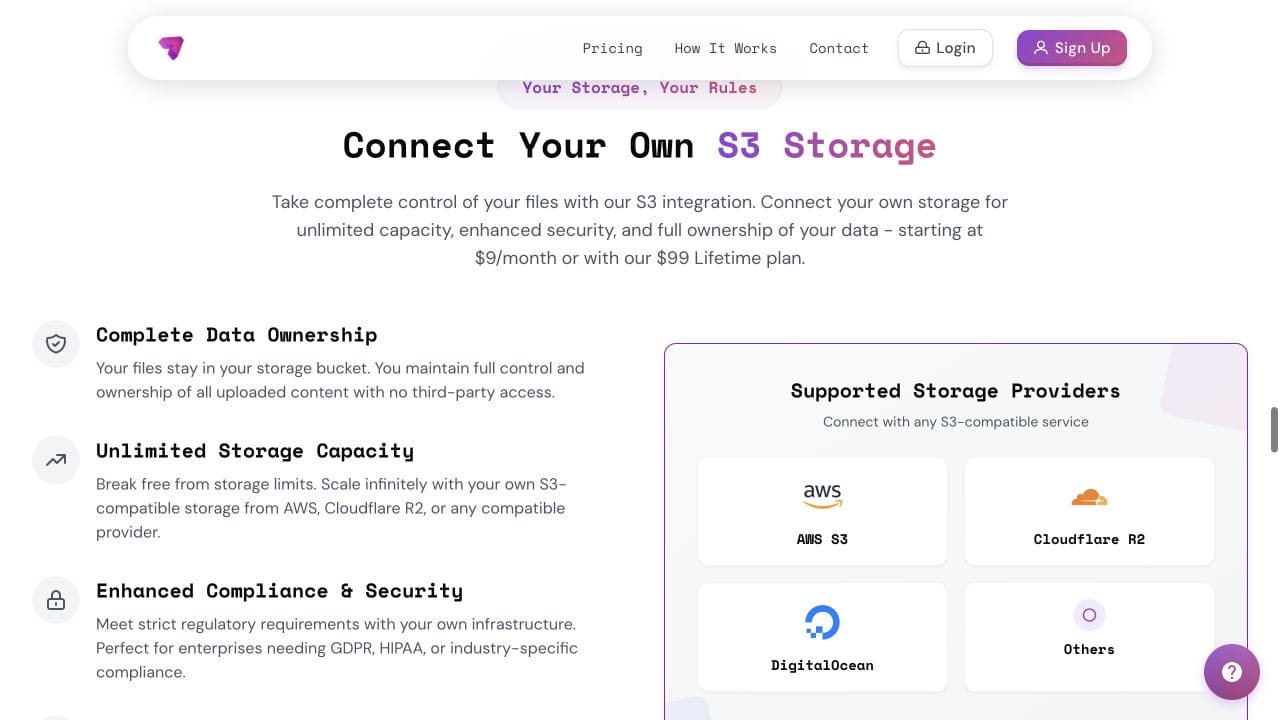
The current HeftySend plans include custom S3 connections on Premium at $9 USD per month, Ultra at $39 per month and Lifetime at $99 once. Lifetime requires your own storage. The free plan is a way to try file sending, not a free custom bucket connection.
HeftySend provides the sending and recipient experience around your storage. Supported file previews help clients identify what you sent, and paid custom download pages let you choose templates and personalise the delivery. You do not need to build that interface yourself.
What would a small delivery archive cost?
This illustrative model uses 100 GB in Cloudflare R2 Standard, retained for one full 30 day billing period. Assume unused monthly allowances, no other account usage and no optional services or taxes. It is a calculation, not a measured customer bill.
R2’s published tariff lists $0.015 per GB month, 10 GB months free, one million Class A operations free and ten million Class B operations free. Beyond those allowances, rates are $4.50 and $0.36 per million respectively, with billing unit rounding. Direct egress is free; Standard has no retrieval fee.
| Example line | Calculation | Cost |
|---|---|---|
| Storage | (100 minus 10) × $0.015 | $1.35 |
| Requests | Assumed below both free allowances | $0 |
| Direct egress | Five complete collections: 500 GB | $0 |
| HeftySend Premium | One month | $9 |
| Total | Provider plus HeftySend | $10.35 |
Twenty collections mean 2,000 GB delivered; this estimate stays unchanged if requests remain within allowances. Retaining the same archive for three identical periods gives $4.05 storage plus $27 Premium, or $31.05. Account usage and billing boundaries matter.
Why can downloads outgrow the stored file size?
Your stored collection and the bytes people receive are different quantities. A 100 GB collection saved once does not become a 500 GB collection when five people download it. It does, however, represent 500 GB of complete file deliveries before retries or other traffic.
Use this planning calculation: delivery volume = collection size × complete collections. Then replace the simplified assumptions with your provider’s usage report. Partial downloads, previews and repeat attempts make real usage less tidy. Do not equate one person clicking a link with exactly one storage request.
Run at least two scenarios before choosing a provider: the expected collection pattern and a busier month. This makes the budget useful even when a client forwards the authorised delivery to more people or collects it on several devices.
What can make the estimate misleading?
- Ignoring other projects. Check the whole account before treating an allowance as available for this delivery.
- Forgetting old versions. Confirm what remains in storage after your intended cleanup, including retained copies.
- Using the cheapest storage class without checking access. Review retrieval costs and minimum retention before selecting an archive option.
- Counting only filenames. Use measured operation totals once the workflow is running, rather than assuming every file creates one request.
- Leaving out supporting services. Add any separately billed delivery, backup or processing service you choose.
Before promising a client a collection period, make sure the storage cleanup policy matches it. A cheaper estimate is not useful if the originals disappear before the client can collect them. Keep a separate backup and agree what happens after the delivery window.
Should you choose Lifetime to remove the monthly plan fee?
Lifetime replaces the recurring HeftySend subscription with a $99 initial purchase, while the provider continues billing for storage and usage. For your own budget, place that purchase in the first period instead of spreading it across an invented lifetime.
Compare the expected length of use and the features you actually need. If a normal included storage plan already handles your transfers, owning a bucket is an additional responsibility rather than an automatic saving. Our guide to sending files with your own storage helps you choose the arrangement.

How do you turn the model into a working budget?
- Write down the full collection size and intended retention period.
- Estimate expected and busy month downloads.
- Check the chosen provider’s current rates, allowances and billing units.
- Add the HeftySend plan, other services and applicable taxes.
- After a small real delivery, compare the provider’s usage report with your assumptions.
- Review retained files and the next collection deadline before deleting anything.
Use the current storage tutorials for connection instructions. If the terminology is unfamiliar, the short AWS video below introduces object storage. It is background on the storage model, not a quotation or a HeftySend performance test.
Frequently asked questions
Does no HeftySend bandwidth charge mean my whole delivery is free?
No. Your plan and any provider charges still apply. Keep those lines separate when comparing options.
Does Lifetime include a storage allowance?
Lifetime requires your own S3 storage. Budget for that provider separately from the initial HeftySend purchase.
Is a bucket the same as a backup?
A delivery bucket is not automatically a separate backup. Decide how you will retain and recover your source files independently of the client transfer.
Can I share one link with several recipients?
Plan for each authorised recipient who may collect the files, including repeat collections. The stored size alone will not describe that activity.
Should I make the bucket public to simplify delivery?
No. Follow the supported connection guide and share the completed transfer link. Our S3 address guide explains the difference between a storage endpoint and a recipient link.
How often should I review the estimate?
Check after the first delivery and whenever volume, retention or provider pricing changes. Use measured account usage to replace your initial assumptions.
Rates checked on 4 October 2026. All example amounts are USD, before taxes and excluded services. Custom storage requires a paid HeftySend plan.